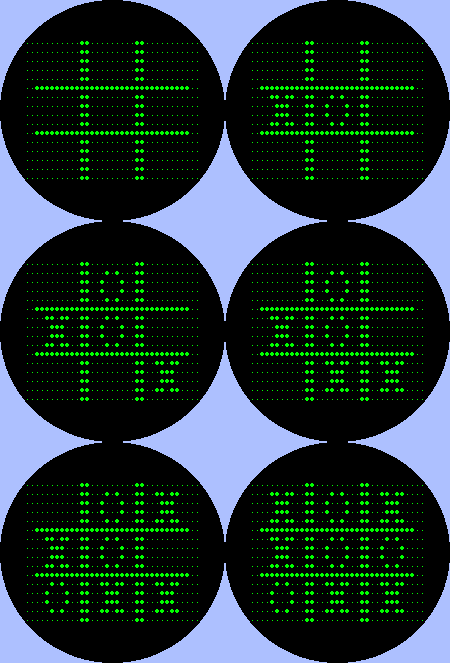
Noughts And Crosses - The oldest graphical computer game
Introduction
Electronic calculators appeared between the two world wars, mostly because
of the need of calculating balistic calculations. Each balistic weapon used
a specific hand calculated table of trajectories. Calculating a single table took a
considerable amount of time.
Electronic calculators partially solved this problem until computers arrived.
They were the next generation of electronic calculators: they executed a
sequence of instructions called program (software).
In the 1940s, computers had very limited abilities and could only
execute a very short program. But they were revolutionar. They
could compute a table of square roots, solve complex equations, etc.
EDSAC, first computer (United Kingdom, 1949)
The first programs in the world were written on EDSAC,
a unique computer built in 1949 at the University of Cambridge
in the United Kingdom. One computed a table of square roots,
another computer a table of prime numbers.
Early computers like EDSAC occupied a huge place, mainly
because they used vaccuum tubes (the semi-conductors predecessors)
which took much more place than a microprocessor and required a
lot of power. Computers were also limited by two other factors:
their speed and their memory. Computing a typical arithmetic table
often required many hours or even days (something that
engineers were used to).
EDSAC used 32 mercury delay lines (or "long tanks") storing 1024
words. Each tank stored 16 words of 35 bits. EDSAC also used 3
monitor tubes (CRTs), one of which displayed the contents of one
of the long tanks. Thus, the display was a matrix of 35 x 16 dots.
EDSAC was not very stable but worked pretty well. It operated 600
instructions per second.
Noughts and Crosses by A.S. Douglas
The picture shown on the top of this page is a simulation of
Noughts And Crosses, a Tic-Tac-Toe game programmed in 1952
by A.S. Douglas who was passing his PhD degree at the
University of Cambridge. His ingenious idea was the use of the
tank display CRT as 35 x 16 pixel screen to display his game.
The game was played against the machine and the player determined
who played first (EDSAC / USER). Once the game started, the player
specified where he wanted to place his nought or cross using a
mechanical telephone dialer.
The reason why A.S. Douglas programmed this game is his PhD
dissertation about Human-Computer interraction. People willing to
read this dissertation will need to visit the library of the
University of Cambridge in order to obtain a copy.
People willing to simulate this game can follow
this link
to download the latest version of the EDSAC simulator
(both MAC and PC versions are available). The software
includes a number of programs and subroutines, recent
contributions from EDSAC amateurs, as well as a very
detailed documentation for those willing to write EDSAC
programs.
Noughts and Crosses is considered as being the first real
graphical computer game and preceeds Space War by almost a decade. One might wonder why it had no success outside
of the University of Cambridge. The reason is obvious: EDSAC
was unique, so nobody could play the game outside of the
University.
Below is the text output of a game I tried on the
EDSAC Simulator...:
|